Views: 0 Author: Site Editor Publish Time: 2026-05-22 Origin: Site
Extruding polycarbonate demands a strict balance of thermal physics and fluid dynamics. Unlike more forgiving plastics, this polymer features a notoriously high melt viscosity. It also shows extreme moisture sensitivity. These exact traits make precise thermal management the primary driver of production yield and optical clarity. Any slight deviation from the optimal temperature range drastically alters product quality. For manufacturers evaluating new equipment lines, grasping advanced heat control is essential. You must understand every processing stage, from raw material pre-drying to gradual downstream cooling. Mastering these steps mitigates expensive scrap rates. It helps operators avoid severe dimensional fluctuations. Ultimately, optimizing these thermal parameters allows you to scale high-tolerance manufacturing efficiently.
Moisture is the first thermal barrier: Heating PC with >0.02% moisture triggers hydrolysis, molecular chain breakdown, and surface splay marks.
Narrow processing window: The optimal melt zone lies between 225°C–260°C; exceeding 280°C risks immediate thermal degradation and yellowing.
Die temperature dictates flow: Advanced CFD (Computational Fluid Dynamics) simulations prove that even minor localized temperature shifts in the die alter pressure drops and cross-sectional flow velocities.
Cooling requires stress management: Rushing the cooling process locks in internal stress, making the extruded PC polycarbonate sheet vulnerable to crazing during secondary fabrication.
Poor thermal management directly degrades your return on investment. It creates massive material waste. You will face rejected batches and prolonged machine downtime. A PC polycarbonate sheet requires strict processing conditions to remain profitable. Frequent temperature fluctuations force production lines offline, destroying your operational efficiency. Understanding the exact thermal profile of this material prevents these costly interruptions.
Polycarbonate is an amorphous thermoplastic. It lacks a sharp, crystalline melting point. Instead, it softens gradually over a broad temperature range. The Glass Transition Temperature (Tg) sits at approximately 147°C. Below this point, the material remains rigid. Above it, the plastic enters a rubbery state. The functional melting threshold requires pushing the material between 225°C and 250°C to achieve proper flow.
When operators fail to maintain this narrow processing window, specific structural and visual defects emerge immediately. We can map these failures directly to their thermal causes:
Too cold: High viscosity prevents the resin from clearing the die smoothly. This induces melt fracture. It causes severe surging, leaving you unable to sustain a continuous output or maintain uniform thickness.
Too hot: Exceeding 280°C initiates rapid polymer degradation. The material undergoes noticeable yellowing. Furthermore, the final product loses its signature impact resistance, rendering it useless for structural applications.
Applying intense extrusion heat to damp polycarbonate destroys the material from the inside out. This happens through a chemical reaction called hydrolysis. Moisture vaporizes inside the heated barrel. This expanding steam violently severs the polymer chains. You will see bubbles and silver splay marks streaking across the surface. The molecular weight drops significantly, leaving the final product incredibly brittle.
Industry standards demand rigorous pre-drying protocols. You must dry the resin pellets aggressively before they ever reach the feed throat. Standard parameters require baking the material at 120°C to 130°C for two to four hours. Your absolute maximum allowable moisture content is 0.02%.
For enterprise-scale operations, standard hopper dryers often fall short. Large factories deploy dedicated "Dry Rooms" and advanced desiccant systems to handle continuous feedstocks. These enclosed environments rely on highly controlled dew points, typically ranging from -20°F to -40°F. Such low humidity allows continuous processing of high-volume materials. You avoid drying bottlenecks entirely while ensuring zero moisture reabsorption occurs during transit to the hopper.
Parameter | Industry Standard Requirement | Consequence of Failure |
|---|---|---|
Drying Temperature | 120°C – 130°C | Incomplete moisture removal or pellet clumping. |
Drying Duration | 2 to 4 hours | Trapped core moisture causing internal bubbling. |
Target Moisture Content | < 0.02% | Hydrolysis, reduced impact strength, splay marks. |
Desiccant Dew Point | -20°F to -40°F | Atmospheric moisture re-enters the resin stream. |
Moving into the barrel, operators must orchestrate exact temperature control. The extrusion screw features distinct physical zones. Each serves a specific thermal function designed to melt the resin progressively.
Feed Zone: This section gently preheats the solid pellets. It prevents sudden thermal shock and ensures smooth conveyance forward.
Compression Zone: Also known as the transition zone, this area increases pressure. The changing flight depth applies high shear, forcing the transition from solid to a homogenous melt.
Metering Zone: This final section stabilizes the melt temperature. It ensures steady pressure distribution right before the material enters the die block.
A critical implementation reality involves friction. High screw speeds generate excessive shear heat naturally. PID (Proportional-Integral-Derivative) controllers cannot merely activate electrical heaters. They must also trigger rapid liquid or air cooling mechanisms. This bidirectional control prevents frictional degradation during high-speed runs.
Maintaining stable melt temperatures minimizes dangerous pressure pulsations. Surging ruins gauge consistency during sheet extrusion. A stable thermal profile ensures your breaker plate and downstream filtration screens operate safely. These internal components routinely handle backpressures exceeding 5000 psi. Any sudden viscosity spike could catastrophicly rupture the screen packs or damage the screw.
Upon exiting the die lips, polycarbonate tends to expand volcanically. Engineers call this the die swell phenomenon. The polymer chains, previously compressed inside the barrel, relax and widen. Uniform temperature across the die body mitigates severe dimensional fluctuations. When temperatures fluctuate across the metal lips, fluid viscosity changes locally. The swell becomes uneven, creating warped edges and thick bands.
Modern PC sheet extrusion tooling replaces trial-and-error design with Computational Fluid Dynamics (CFD). Multi-region modeling predicts exactly how the polymer behaves inside complex coat-hanger dies. Localized temperature variations at the die wall heavily influence viscosity. They alter the internal pressure drop. They shift the continuous flow rate across the entire cross-sectional profile.
This precision becomes overwhelmingly critical during co-extrusion. Manufacturers often run a secondary extruder to apply specialized UV-resistant layers directly onto the top surface. This process demands an intricate thermal balancing act. You must merge two distinct melt streams at slightly different viscosities. If the temperatures mismatch, the secondary layer disrupts the primary flow, causing interfacial instability and hazy streaks.
Cooling solidifies the product, but executing it improperly ruins the structural integrity. Different geometries demand completely distinct thermal approaches in plastic sheet production.
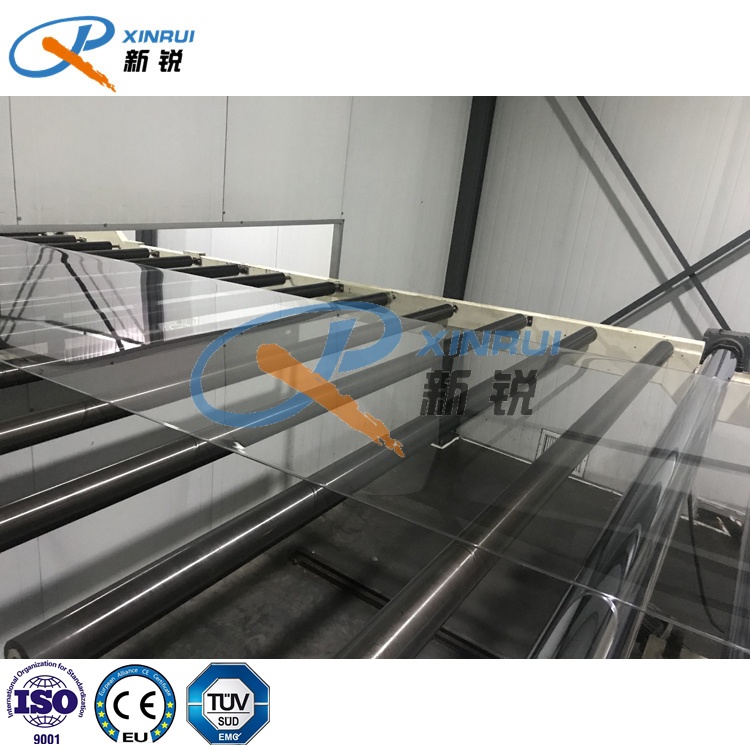
Solid sheets utilize highly polished, temperature-controlled chill rolls. You typically pass the hot web through a three-roll calendar stack. These rolls maintain surface temperatures carefully calibrated between 80°C and 120°C. This specific thermal range locks in the glossy surface finish. It ensures absolute dimensional stability without shocking the plastic.
Multiwall sheets require radically different handling. You must deploy elongated vacuum calibration tanks. These units integrate precise water cooling systems. The vacuum forces the outer walls against the calibrator plates. This instantly freezes the internal rib structures, preventing the hollow cavities from collapsing under their own residual heat.
Regardless of the final geometry, you must ensure a gradual thermal transition past the Tg. Slowly cooling the sheet below 147°C is mandatory. Rapid quenching locks in severe residual stress. This trapped molecular tension causes delayed product failures. The sheet will suffer severe crazing or stress cracking later when end-users subject it to drilling, bending, or contact with aromatic solvents.
Before investing capital, procurement teams and manufacturing engineers must verify the thermal capabilities of any potential equipment. Standard features found on generic plastic extruders rarely suffice for high-viscosity resins like PC. You need specialized hardware engineered specifically for rigorous thermal management.
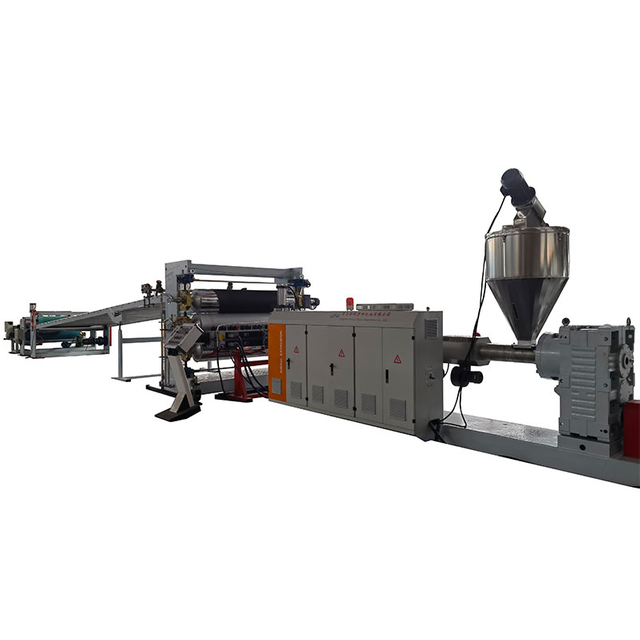
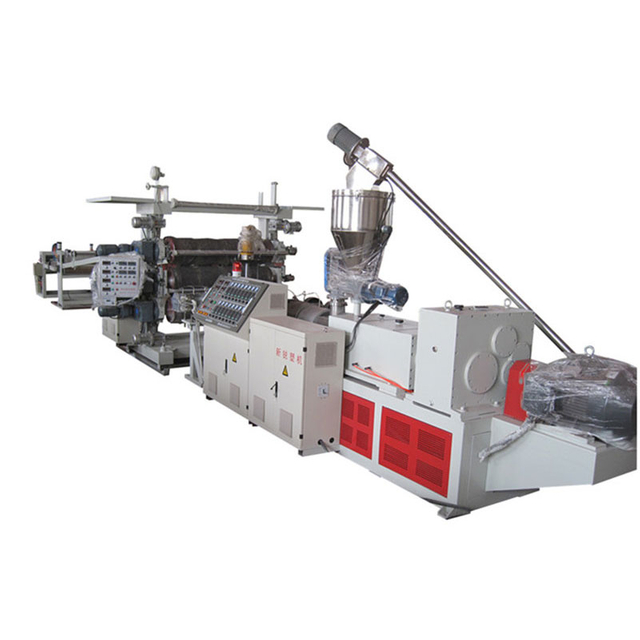
Below is a summary chart functioning as an evaluation framework for buyers assessing a polycarbonate sheet machine:
Evaluation Category | What to Verify | Why It Matters for PC |
|---|---|---|
PID Responsiveness | Does the machine offer true multi-zone, closed-loop thermal regulation? | Reacts instantly to shear friction, preventing localized burning inside the barrel. |
Screw Geometry | Is the screw specifically profiled for high-viscosity resins? | Minimizes mechanical shear-induced burning while maintaining high output rates. |
Downstream Control | Are the cooling rolls and vacuum calibrators robustly zoned? | Handles exact gauge thicknesses without inducing rapid quenching or internal stress. |
Lowering operational costs requires smart parameter optimization. You achieve better margins by combining high-quality die design with relaxed non-critical tolerances. Focus heavily on reducing your daily scrap rate rather than compromising on base equipment quality. Superior thermal hardware pays for itself rapidly by maximizing prime-quality output and minimizing material degradation.
Mastering PC sheet extrusion fundamentally relies on respecting its incredibly narrow thermal processing window. You must manage its extreme moisture aversion flawlessly. Every stage of production requires vigilance. Pre-drying prevents internal hydrolysis. Multi-zone PID control prevents frictional degradation. Gradual roll cooling prevents latent stress cracking.
As you evaluate potential equipment partners, demand empirical evidence of thermal competence. Request comprehensive material test runs using your specific resin grades. Review their CFD data for die designs. Finally, audit the closed-loop temperature control systems closely before signing any final procurement agreements.
A: The optimal melt temperature typically ranges from 230°C to 260°C. Exact settings depend on sheet thickness, the resin's molecular weight, and your specific screw design. Pushing temperatures above 280°C risks severe thermal degradation and immediate product yellowing.
A: Yellowing serves as the primary visual indicator of thermal degradation. It usually occurs when the melt temperature exceeds 280°C. It also happens if the resin remains trapped inside the hot extruder barrel for too long, breaking down the polymer chains.
A: It is absolutely critical. You must dry PC to under 0.02% moisture content, usually by holding it at 120°C for 2-4 hours. Failure to dry the resin causes internal moisture vaporization at extrusion temperatures. This creates bubbles, splay marks, and brittle sheets.
A: Die swell is the volumetric expansion of the polymer melt immediately as it exits the die lips. Melt temperature and barrel pressure heavily influence this expansion. It requires careful downstream calibration and precise cooling roller setups to maintain tight dimensional tolerances.