Views: 0 Author: Site Editor Publish Time: 2026-05-20 Origin: Site
The medical device manufacturing sector is currently undergoing a massive transformation. The industry is rapidly shifting away from bulk, low-tolerance tubing. We are now moving toward highly specialized, micro-precision applications. Surgeons demand complex multi-lumen structures and ultra-thin walls to execute minimally invasive procedures safely. For manufacturers, deploying a medical tube extrusion line for PVC catheter production presents a strict thermodynamic challenge. You must carefully balance high-speed throughput against the extreme thermal sensitivity of medical-grade PVC.
Achieving success in this environment requires flawless operational control. A successful production line achieves micro-level dimensional stability. You must often hit strict ±10-micron tolerances without inducing polymer degradation. Reaching these targets ensures ISO-compliant clinical performance every single time. It also heavily minimizes costly scrap rates on your factory floor. In this guide, we will explore exactly how clinical requirements dictate machine architecture. You will learn about downstream calibration protocols, critical closed-loop automation strategies, and the essential criteria for vetting equipment partners.
Material Sensitivity is the Bottleneck: PVC begins to thermally degrade at temperatures as low as 120°C; standard "universal" extruders will cause over-shearing and material breakdown.
Precision Equals Cost Reduction: Upgrading to closed-loop dimensional control and vacuum calibration can reduce high-value medical material usage by up to 12.5% through tighter tolerances.
Cooling Dynamics Matter: Improper quenching or short cooling troughs lead to internal heat retention, changing the mechanical properties (flexibility, kink resistance) of the final PVC medical tube.
Automation is Mandatory for Compliance: Modern lines rely on integrated multi-axis lasers and ultrasonic sensors feeding directly into PLC systems to maintain cleanroom-ready, intervention-free manufacturing.
Surgeons generally do not consider polymer melt pressures or extruder RPMs. They care exclusively about how a device feels and performs during a critical insertion. Mapping these demanding end-user requirements backward to specific manufacturing capabilities is vital for your success. You must effectively translate subjective clinical feel into hard, measurable process data.
Every physical trait of a surgical device traces back to a specific thermal or mechanical setting on your extrusion line. Small deviations cascade into massive clinical failures.
Pushability and Torque: During intricate cardiovascular procedures, doctors rely on 1:1 torque response. If they twist the proximal end, the distal tip must respond equally. This characteristic comes directly from strict structural integrity during extrusion. You achieve this through perfectly concentric walls. In advanced setups, you might use co-extrusion strategies embedding rigid polymers or stainless-steel wire braiding.
Flexural Stiffness and Kink Resistance: A kinked tube inside a patient creates an immediate emergency. Device flexibility depends heavily on exact heating and cooling rates during the extrusion run. These thermal cycles dictate the polymer's internal structure. Rushed cooling processes permanently alter the crystallinity of the plastic, rendering it brittle or prone to sudden collapse.
Medical PVC remains a highly preferred material across the global healthcare industry. It offers unparalleled biocompatibility, distinct cost-effectiveness, and excellent flexibility. However, medical PVC is exceptionally prone to shear-induced and thermal degradation. It acts like a highly sensitive fluid under pressure.
Small fluctuations in your melt pressure directly correlate to rough surface finishes. A rough, degraded surface acts as a microscopic breeding ground for bacterial risks. It also dramatically increases friction during surgical interventions. You cannot process this material using aggressive force. You must control every thermal variable tightly to maintain a pristine, glass-like finish on the final product.
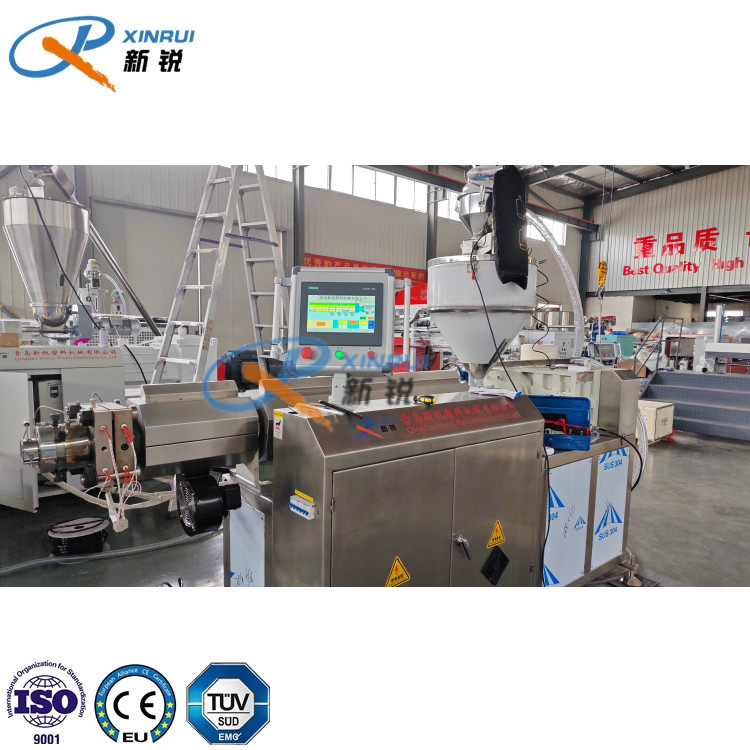
Evaluating the primary host machine is your first major operational step. You must look for specific mechanical dimensions to prevent material breakdown and ensure absolute flow consistency. A standard machine simply cannot handle heat-sensitive polymers effectively. Choosing the right medical tube extruder establishes your baseline quality and protects your raw materials from burning.
Avoid vendors pushing general-purpose screws for medical applications. PVC processing requires highly specialized barrier screw designs. These specialized screws melt the polymer evenly at low temperatures. They achieve this without inducing dangerous over-shearing. Excessive friction easily pushes the PVC melt past its rapid degradation threshold.
Furthermore, you must evaluate specific alloy requirements early in the procurement phase. If your facility will occasionally pivot to handle corrosive fluoropolymers like FEP or PTFE alongside PVC, standard steel will fail. You must specify Hastelloy barrels and screws to prevent severe chemical corrosion inside the machine.
Integrating high-precision gear pumps into your line is absolutely non-negotiable. Traditional extruders often suffer from slight pulsations in output. Gear pumps actively eliminate this extruder surging. They guarantee an exact volumetric output regardless of minor backpressure changes downstream.
This stabilization becomes mandatory when you target ultra-tight micro-tolerances. Without a gear pump, the polymer flow naturally fluctuates. These fluctuations create unpredictable thick and thin spots along the length of the tubing.
You need specialized cross-head dies equipped with highly streamlined internal flow channels. This geometry specifically eliminates material "dead zones." Any polymer stagnation inside the die immediately leads to burnt, degraded material. Such flaws instantly reject entire production batches and force full line shutdowns for cleaning.
General vs. Precision Extruder Architecture | ||
System Component | Standard Industrial Extruder | Precision Medical Extruder |
|---|---|---|
Screw Design | Universal/General Purpose | Low-shear barrier screw optimized for PVC |
Mass Flow Control | Direct from extruder (high surge risk) | Integrated precision melt gear pump |
Die Geometry | Standard inline die (prone to stagnation) | Cross-head die with highly streamlined channels |
Alloy Construction | Standard hardened steel | FDA-grade stainless or Hastelloy components |
How the machine handles the polymer immediately after it exits the die heavily dictates your overall yield rate. High production speeds often directly conflict with high precision. Managing this delicate thermodynamic balance determines the ultimate commercial success of your catheter production line.
Calibration requires a simultaneous dual approach to lock in dimensions instantly before the plastic sags or distorts.
External Sizing: High-stability vacuum calibration tanks lock the outer diameter securely. These tanks pull the semi-molten material outward against highly precise sizing sleeves using negative pressure. Water simultaneously cools the exterior to freeze the dimension in place.
Internal Sizing: Micro-regulated low-pressure air injection sustains the internal lumen cavity. Systems must control this internal air pressure accurately to ±0.002 bar during rapid cooling. If the pressure drops, the inner walls collapse. If the pressure spikes, the tube balloons out of spec.
Many manufacturers struggle with hidden thermal defects occurring long after the plastic leaves the die. Understanding cooling dynamics prevents this common trap.
Risk Profile: Rushing the cooling process causes massive latent quality issues. If you utilize a water trough that is too short for your line speed, the core of the PVC medical tube remains thermally hot. As the tubing exits the final water bath, this internal heat migrates outward. The residual heat acts to soften the exterior again. This alters the physical consistency, warps the wall thickness, and destroys your kink resistance.
Solution: You must specify strictly calculated cooling lengths. Base these physical calculations on your maximum desired line speeds and your thickest wall profiles. Ensure thorough, deep quenching. This delays unwanted crystallization and maintains uniform flexibility throughout the entire tube cross-section.
Modern medical manufacturing severely limits manual intervention. Shifting from operator reliance to automated statistical process control (SPC) protects your product consistency. It also satisfies strict regulatory audit requirements dictated by global health agencies.
You simply cannot manage what you do not measure continuously. Batch sampling is no longer sufficient for Class II and Class III medical devices. You need inline sensors scanning the product continuously.
Multi-axis laser micrometers: These devices scan the tube constantly from multiple angles. They provide continuous Outer Diameter (OD) monitoring and detect microscopic ovality issues instantly.
Gamma backscatter or ultrasonic probes: These advanced tools validate wall thickness in real-time. They shoot waves through the plastic to measure inner dimensions without touching the sterile surface.
Concentricity validation: Ultrasonic reflection mapping ensures perfectly centered lumens. This guarantees the wall thickness remains perfectly even across all 360 degrees of the tube.
Simply triggering red flashing alarms is no longer sufficient for modern cleanrooms. Intelligent automation requires true closed-loop feedback. The PLC must autonomously micro-adjust machine parameters without human input.
When inline sensors detect a dimensional shift, the system must react instantly. The PLC tweaks the screw RPM or adjusts the capstan haul-off tension within milliseconds. This rapid, automated response is critical for maintaining high line speeds safely. It completely eliminates manual guesswork from the floor and vastly reduces raw material waste during startup phases.
Evaluating a machinery supplier goes far beyond comparing the raw iron and steel specs. You must aggressively vet them as a true OEM partner. They must prove capable of supporting rigorous regulatory environments and complex validation procedures.
The physical footprint of the machine must natively support ISO Class 7 or 8 cleanroom environments. You cannot retrofit a dirty machine into a clean space.
Look specifically for FDA-grade stainless steel surfaces that operators can wipe down aggressively. Ensure all drivetrains and belts are fully enclosed to prevent dust generation. The equipment must generate absolutely no particulate matter during continuous high-speed operation. Water and power utilities should route cleanly to avoid tripping hazards or dirt traps.
Regulatory bodies demand complete traceability for every millimeter of tubing produced. Ensure the HMI and PLC systems inherently log all batch data securely. They must handle electronic recipe management natively, preventing unauthorized operators from changing critical thermal parameters.
Generating reliable, unalterable audit trails is fundamentally required for CE and FDA documentation. If the machine cannot export secure production logs via centralized SCADA systems, it is not truly medical-grade.
Piecing together a line from multiple vendors creates massive integration risks. Prioritize vendors offering comprehensive validation and turnkey integration under one roof.
They should provide full Factory Acceptance Testing (FAT) at their facility and Site Acceptance Testing (SAT) at yours. Force them to prove ±0.03mm or tighter tolerances using your exact PVC compound before you authorize shipment. This validation phase proves the machine can actually deliver the clinical precision you require using real-world materials.
Investing heavily in a precision extrusion line for PVC catheters acts as a massive exercise in rigorous risk mitigation. Legacy lines rely far too heavily on operator intuition and manual tension adjustments. Conversely, modern systems utilize advanced thermodynamic design and closed-loop data to guarantee dimensional consistency every single time.
To move forward successfully, implement the following action steps:
Audit your current scrap rates immediately, focusing specifically on waste caused by dimensional variations or visual thermal degradation.
Challenge your prospective extruder vendors directly during the RFP process. Ask them to document their closed-loop sensor response times under high-speed conditions.
Demand real-world FAT trials to validate their barrier screw efficacy using your specific PVC resin formulation, rather than generic testing plastics.
Ensure your cooling trough lengths match your aggressive scaling targets to prevent latent inside-out reheating defects.
By enforcing these standards, you elevate your manufacturing capabilities, protect patient safety, and secure your position in the competitive medical device sector.
A: Standard IV tubing generally targets tolerances of ±0.03mm. However, advanced multi-lumen catheters and cardiovascular devices often require tolerances as tight as ±10 microns (±0.01mm). Hitting these strict metrics ensures clinical viability and guarantees compatibility with corresponding surgical connectors.
A: Legacy machines often suffer from severe dead zones in the die. They also use aggressive, general-purpose screw designs. PVC is highly heat-sensitive. Excessive friction caused by over-shearing, combined with prolonged residence time in the barrel, easily pushes the melt past its degradation threshold.
A: It utilizes inline sensors, like multi-axis laser micrometers, to detect microscopic dimensional shifts instantly. The system automatically adjusts haul-off speeds or gear pump outputs in real-time. This completely eliminates manual operator guesswork, stabilizes the process, and drastically reduces raw material waste.