

Views: 0 Author: Site Editor Publish Time: 2026-05-29 Origin: Site


The surging demand for underground cable ducting and internal building wiring is actively driving major investments in specialized manufacturing. Infrastructure projects require reliable pathways for critical power and communication lines. Modern installations rely heavily on specialized piping to protect these vulnerable networks from environmental stress.
Producing high-quality electrical conduit pipe requires carefully balancing structural ring stiffness against material efficiency. This delicate balance dictates very specific machine configurations. Buying an off-the-shelf extrusion line without mapping it to final conduit specifications often leads to material waste. It can also cause inconsistent wall thickness or rapid machine degradation.
This article provides plant managers and B2B buyers with an evidence-based framework. You will learn how to evaluate and select the ideal equipment for your production floor. We will explore how to match polymer materials to specific machine setups for optimal production.
Material dictates the machine: UPVC/CPVC conduits require conical twin-screw extruders due to heat sensitivity,If you are using PVC granules, you can choose to use a PVC single-screw extruder. while PE/MPP conduits perform best with single-screw systems.
Structure determines the line setup: Single-wall flexible conduits require compact, single-extruder setups; double-wall underground ducts demand co-extrusion systems with independent inner/outer wall control.
Precision relies on calibration: Maintaining vacuum pressures of -0.03 to -0.08 MPa is critical for achieving consistent corrugated geometry and high ring stiffness (up to SN40).
Long-term value over upfront cost: Evaluating vendor components (e.g., Siemens PLCs, ABB inverters) ensures a reliable 15-20 year operational lifespan.
Manufacturing electrical sheath pipe presents a unique engineering challenge. You must produce a product featuring a perfectly smooth inner wall. A smooth interior reduces pulling friction when contractors install heavy cables. Simultaneously, you need a highly structured outer wall. This corrugated profile achieves necessary ring stiffness.
Using a corrugated structure provides massive economic advantages. It reduces raw material usage by up to 60% compared to solid pipes. You get the same crush resistance while spending far less on bulk polymers. However, realizing these savings requires precise application-driven requirements.
Consider these core application scenarios before buying equipment:
Internal Building Wiring: This application needs high flexibility and flame retardancy. Manufacturers typically use UPVC to create single-wall flexible pipe.
Underground Cable Ducting: Deep trenches require high crush resistance and long continuous runs. Double-wall HDPE dominates this sector.
Trenchless/Directional Drilling: Horizontal drilling demands extreme rigidity and temperature resistance. MPP (Modified Polypropylene) materials work best here.
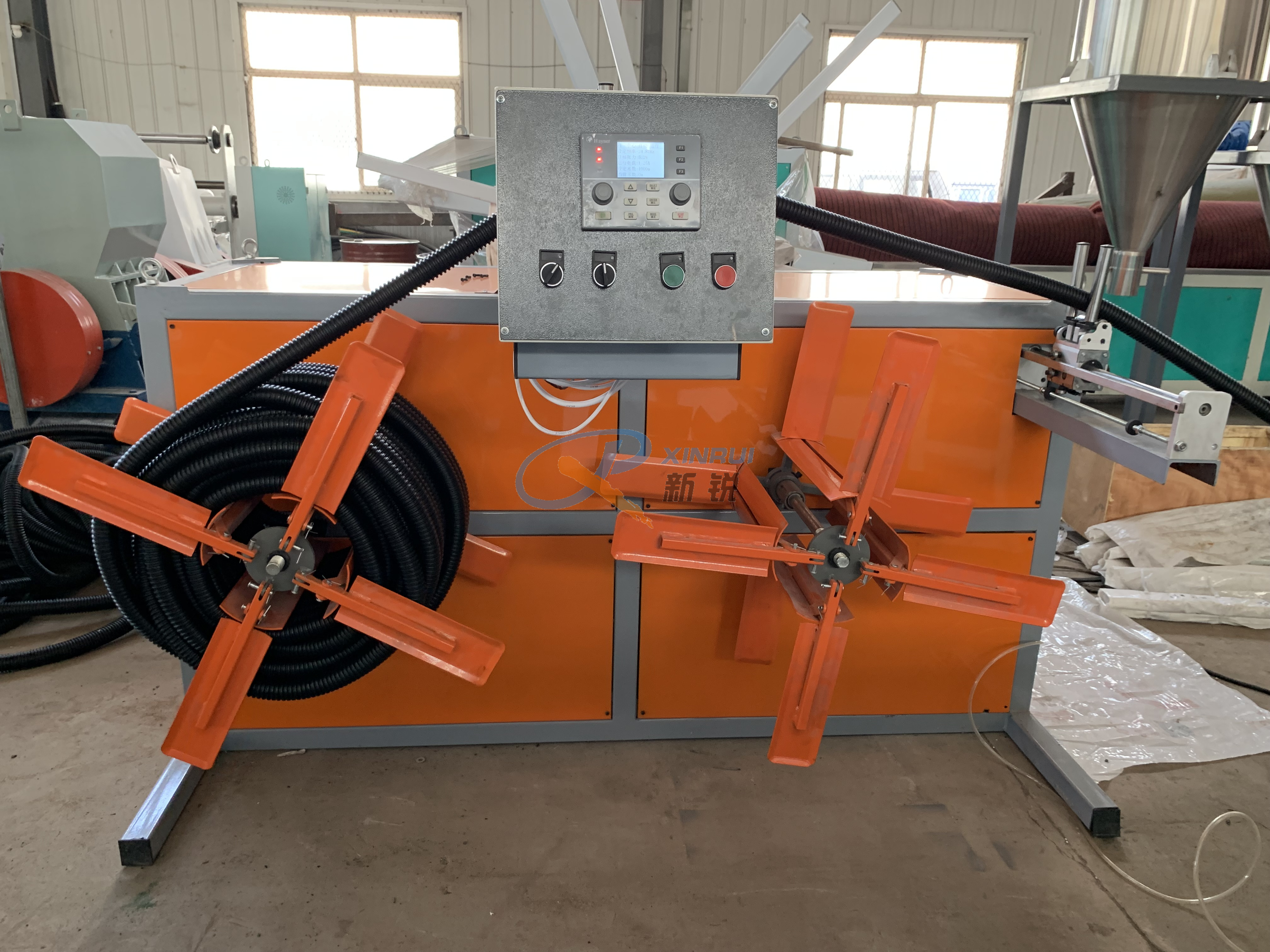
Your target product structure directly dictates your entire factory layout. You must choose the right structural approach before comparing machine specifications. We generally divide these systems into two distinct categories.
Single-wall lines manufacture flexible conduits primarily for residential and commercial building interiors. They feature a straightforward machine configuration.
Machine Configuration: You only need a single extruder,forming machine ,winder and cutting machine. This setup offers a compact footprint and high production flexibility.
Output Capability: These lines are optimized for small-to-medium diameters, typically ranging from 9mm to 250mm.
Packaging: Finished products easily coil into 30-50 meter rolls.
Line Speed: Target production speeds often reach up to 25-40m/min, ensuring high daily turnover.
Double-wall conduits protect high-voltage cables buried underground. Producing them requires a much more complex corrugated pipe extrusion process.
Machine Configuration: You must use a co-extrusion setup. This requires two dedicated extruders working in tandem. They simultaneously form a smooth inner layer and a corrugated outer layer.
Process Complexity: This method requires advanced horizontal corrugators. You also need precise vacuum drawing capabilities. Highly efficient cooling systems are mandatory. They bond the two layers seamlessly without trapping air bubbles.
Selecting an extruder based solely on output capacity is a common mistake. You must map your machine's screw design to the rheological properties of your specific polymer. Different plastics melt, flow, and degrade very differently under pressure.
Polymer Material | Primary Application | Extruder Requirement | Why This Matches |
|---|---|---|---|
UPVC / CPVC | Flame retardant building conduits | Conical twin-screw extruders | Heat-sensitive material prone to degradation. Needs low shear forces and short L/D ratios. |
PE / HDPE/PP | Flexible & underground sheathing | High-efficiency single-screw extruders | Excellent flow characteristics. Benefits from spiral die heads for uniform melt distribution. |
MPP | Power grid directional drilling | Single-screw with barrier design | Highly sensitive to shear stress. Specialized screws ensure stable temperatures. |
Manufacturers rely on UPVC for flame-retardant building conduits. However, PVC is incredibly heat-sensitive. It degrades rapidly if exposed to excessive friction. Therefore, you must use conical twin-screw extruders. They provide strong mixing capabilities at lower RPMs. They utilize low shear forces and short L/D ratios to prevent material burning.
When manufacturing PE corrugated pipe, the rules change entirely. Polyethylene boasts excellent flow characteristics. You need high-efficiency single-screw extruders. Look closely at the die head design. Spiral die heads ensure uniform melt distribution. Furthermore, modern energy-saving single screws can reduce your total power consumption by up to 35%.
Modified Polypropylene (MPP) protects heavy power grids. MPP is highly sensitive to shear stress during extrusion. Standard screws will damage the polymer chains. You need single-screw extruders featuring barrier screw designs. This geometry physically separates the solid bed from the melt pool. It ensures stable melt temperatures and prevents structural weaknesses in the final pipe.
Every corrugated pipe machine relies on several synchronized subsystems. If one component fails or falls out of calibration, the entire production line suffers. Understanding these critical parameters helps you maintain strict quality control.
The corrugator functions as the beating heart of your production line. It must maintain a continuous, flawless chain of mold blocks. The hot polymer melt enters these blocks to take its final shape. High-quality corrugators use precision-machined aluminum alloy blocks. They run on heavily lubricated tracks to prevent micro-stutters during high-speed production.
Dimensional accuracy depends entirely on your vacuum calibration system. Operating vacuum pressures must remain tightly controlled. Keep your gauges dialed between -0.03 to -0.08 MPa. This negative pressure ensures the hot polymer fully conforms to the mold block grooves. It decisively defines the pipe’s outer geometry and overall ring stiffness.
You must extract heat from the plastic rapidly to freeze its shape. Cooling water temperatures must be maintained precisely at 10–25°C. This temperature range minimizes residual stress in the finished pipe walls. Always opt for enclosed water cooling over standard air cooling. Enclosed water cooling generally yields significantly higher production rates and better dimensional stability.
Screw length-to-diameter (L/D) ratios determine how well your machine melts raw plastic pellets. Standard configurations should feature L/D ratios between 25:1 and 30:1. This range provides optimal plasticization for standard polyolefins. It gives the material enough time to melt evenly without overheating.
Purchasing a new extrusion line represents a massive capital investment. You must evaluate manufacturers rigorously. Look beyond the initial purchase price and focus on long-term operational viability.
Look for vendors capable of supplying the entire production line. They should provide everything from auto-feeders to inline belling machines and stackers. Sourcing components from multiple vendors creates severe integration gaps. You want one unified system that communicates seamlessly.
Next, verify the brand tier of the electrical and control components. You should demand components like Siemens or Schneider for PLCs, and Danfoss or ABB for drives. These premium components directly dictate maintenance frequencies. They ensure a reliable 15-20 year operational lifespan for your equipment.
Many vendors advertise theoretical maximum output rates. Do not rely on these numbers. Evaluate machines based on stable, continuous output rates instead. Request empirical performance data specific to your target pipe diameter and your exact polymer material. An honest vendor will provide test run data rather than sales brochure maximums.
Always verify global certifications. Ensure the equipment meets ISO 9001 and CE standards. These certifications reflect strict adherence to international safety regulations. They also prove the vendor maintains rigorous internal quality control norms.
Even the best corrugated pipe machine will encounter operational hurdles during commissioning. Your engineering team must anticipate these issues to minimize costly downtime.
The most common adoption risk involves facility infrastructure. Plant managers often underestimate the aggressive cooling requirements of modern lines. If your factory chilling system cannot supply enough cold water, you cannot run the extruder at full speed. This bottleneck drastically limits your maximum extrusion speed and harms ROI.
Uneven Wall Thickness: Operators frequently spot thin spots in the pipe wall. This defect is typically caused by severe die imbalance. It can also stem from extruder pressure fluctuations. Check your melt pump settings and realign the die-centering bolts immediately.
Irregular Corrugation Geometry: If the outer ridges look deformed, check your heat zones. This flaw is usually traced back to unstable melt temperatures. You should strictly hold temperatures between 170–230°C depending on the polymer. Insufficient vacuum pressure or worn mold blocks also cause this issue.
Poor Inner/Outer Layer Bonding (Double-Wall): The smooth inner wall must bond flawlessly to the corrugated outer wall. Delamination indicates a critical process failure. It requires immediate recalibration of the co-extrusion speeds. You must also adjust the melt temperatures of both layers to ensure they fuse perfectly inside the corrugator.
Selecting the right machinery is fundamentally an exercise in reverse-engineering your final product. You cannot buy generic equipment and hope it performs well across multiple distinct applications. Success demands precision matching.
We recommend starting with your specific application parameters. Define the exact material, whether you need single or double walls, the target diameter, and the required ring stiffness. Use those specific parameters to dictate the extruder screw design, cooling capacity, and control systems.
Your next step should involve direct vendor consultation. Contact reputable manufacturers to request material-specific extrusion trials. Review their component lifecycle data and service agreements carefully before issuing a final request for quotation.
A: Corrugated profiles achieve high structural ring stiffness while utilizing up to 60% less raw material. This highly efficient design dramatically lowers overall production costs. It allows manufacturers to remain highly competitive while easily maintaining the required crush resistance for demanding installation environments.
A: Generally, no. PVC requires a conical twin-screw setup due to its extreme heat sensitivity. In contrast, PE and HDPE utilize high-efficiency single-screw extruders. Interchanging these materials on the wrong screw design leads to severe polymer degradation, poor mixing, and unmarketable final products.
A: Depending on the mold design, selected material, and programmed wall thickness, quality machines can produce a wide range of conduits. Modern lines comfortably manufacture products ranging from standard SN2 classes up to high-strength SN40 classifications for incredibly demanding, deep underground applications.


