Views: 0 Author: Site Editor Publish Time: 2026-05-21 Origin: Site
In major infrastructure projects, the failure of a concrete seal is often traced back not to the installation. Instead, we find the root cause in micro-variations within the waterstop's extruded profile. A tiny dimensional inconsistency can easily compromise an entire dam, reservoir, or water treatment facility. Configuring the right equipment goes far beyond achieving rapid output speeds. Manufacturers and large-scale suppliers must engineer flawless dimensional stability across every single batch. Your production lines must meet stringent USACE and ACI tolerances consistently to avoid catastrophic field failures. This guide breaks down critical equipment requirements, extrusion die selections, and essential downstream calibration. We explore how precision tooling eliminates residual stress and material shrinkage during continuous runs. You will learn exactly what it takes to produce compliant, contractor-ready profiles for dynamic and static environments. By mastering these technical nuances, you ensure reliable field splicing and protect long-term structural integrity.
Machine configurations must align with specific project profiles (e.g., center-bulb for expansion joints, flat-ribbed for static construction joints) via high-precision interchangeable extrusion dies.
Quality concrete joint sealing relies heavily on the machine’s cooling and haul-off calibration to prevent residual stress, edge warping, or material shrinkage.
Evaluating a PVC waterstop machine requires scrutinizing the screw design’s ability to process specialized compounds without degrading the PVC’s tensile strength or chemical resistance.
ROI is driven by tooling changeover speed, scrap reduction rates, and the ability to maintain uniform thickness for reliable on-site thermal welding.
Construction contractors demand highly specific profile geometries. They select these shapes based on anticipated movement within a construction joint. We see diverse requirements across different infrastructure sites. A dam requires different seals than a commercial basement. Your extrusion equipment must remain versatile enough to handle rapid profile switches without extensive downtime.
Consider the following common end-user demands you must accommodate:
Tear-web profiles: Engineered for areas experiencing extreme shear movements. The web ruptures to protect the primary U-bulb from immense tension.
Labyrinth profiles: Primarily specified for vertical cold joints. They create a complex mechanical path to stop active water migration.
Center-bulb designs: Ideal for high-movement expansion gaps. They safely accommodate significant lateral and transverse structural shifts.
Flat-ribbed layouts: Best suited for static applications where movement remains virtually non-existent.
Dimensional consistency directly impacts field splicing success. On-site installation mandates minimum 10cm overlaps. Contractors rely on precise hot-iron welding to join these sections seamlessly. If your extrusion equipment produces uneven edges, field-welding failures become inevitable. You must guarantee edge uniformity from the first meter to the last.
Regulatory standards dictate your baseline production capabilities. High-stress environments demand high-grade virgin polymers. Your manufacturing line must process this dense material without degrading its physical properties. It must meet industry-standard benchmarks like USACE CRD-C572. Furthermore, facilities serving potable water applications will strictly demand NSF 61 compliance. Machinery configurations must respect and maintain these rigorous compound requirements.
Selecting the right PVC waterstop machine begins at the single-screw extruder. You must evaluate the screw design carefully. The Length to Diameter (L/D) ratio plays a massive role in material processing. An optimal L/D ratio ensures thorough plasticization. It allows the dense polymer to melt evenly without burning. If the ratio is too short, you risk un-melted particles. If it is too long, excessive shear heat degrades the polymer chain.
Operators must also choose between standard and vented barrels. This decision hinges entirely on raw material moisture content.
Standard vs. Vented Extruder Barrels | ||
Feature | Standard Barrel | Vented Barrel |
|---|---|---|
Moisture Handling | Requires highly pre-dried materials. | Extracts moisture and gases during extrusion. |
Material Suitability | Dry, highly stable virgin PVC compounds. | Hygroscopic blends or slightly damp mixtures. |
Porosity Risk | High risk if moisture enters the hopper. | Low risk due to active vacuum extraction. |
Die head design heavily influences your final output geometry. Customized T-dies produce complex shapes like thick center bulbs and ribbed dumbbell ends. Precision machining in the die ensures balanced melt flow across the entire width.
Risk Factor: Poor die flow design creates uneven material distribution. This flaw generates invisible weak points along the ribs or bulbs. Under massive concrete pouring pressure, these hidden defects rupture. They often cause catastrophic leaks in subterranean structures long after contractors leave the site.
We must also implement closed-loop melt pressure and temperature controls. PVC is highly sensitive to thermal degradation. Advanced control systems auto-adjust heater bands continuously. This stability ensures the polymer retains crucial UV, ozone, and chemical resistance traits. The heating phase must remain tightly controlled to avoid compromising the final product.
Successful waterstop production relies heavily on rigorous downstream calibration. Once the melt exits the die, vacuum calibration and water cooling tanks take over. You need essential length and temperature staging to freeze the profile shape instantly. Staged cooling prevents sudden thermal shock while locking in specified dimensions.
Pitfall to Avoid: Inadequate cooling length remains a frequent operational error. It causes the thickest parts of the profile, particularly the center bulb, to sink or deform. If the core remains hot, it shrinks unevenly before coiling.
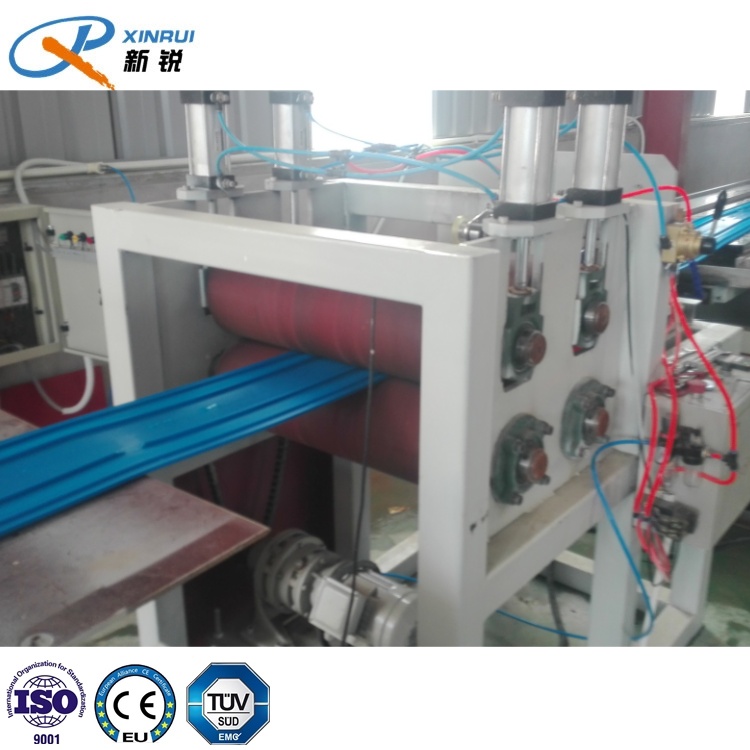
Haul-off tractor units pull the cured profile down the line. You should utilize dual-caterpillar or multi-belt pullers. Equip these traction belts with soft rubber pads. Hard tracks will crush the ribbed structural features, ruining their grip potential in poured concrete.
Synchronization between extruder speed and the haul-off unit is absolutely vital. You must prevent longitudinal stretching. Stretching permanently ruins the specified tensile strength. Follow these sequence controls to ensure harmony:
Install laser micrometers directly after the primary cooling bath.
Link the micrometer data to the main Programmable Logic Controller (PLC).
Set tight parameters for acceptable width and thickness deviations.
Allow the PLC to auto-adjust haul-off speeds in micro-increments.
Conduct manual tension checks at the winder station every operating hour.
Finally, configure your coiling mechanisms thoughtfully. Dual-station automated winders provide uninterrupted operation. Set them for standard 30-meter rolls. They must maintain proper tension throughout the winding cycle. Too much tension creates a permanent bending memory in the plastic. Contractors struggle immensely to lay memorized rolls flat on the job site.
Manufacturing a premium construction waterstop requires strict material discipline. We frequently face debates over recycled versus virgin materials. If blending regrind, your equipment requires specific adaptations like better melt filtration and vented barrels.
However, high-stress infrastructure projects usually prohibit regrind entirely. Specifications demand dense, highly plasticized virgin compounds. The machine must excel at melting this specific formulation uniformly. Do not compromise physical integrity to save marginal amounts on raw material costs.
The industry is seeing rising demand for co-extrusion capabilities. Many contractors want hybrid solutions to tackle complex ground moisture. They request hydrophilic, swellable strips extruded directly onto the rigid base. Evaluating machines capable of this process gives you a competitive edge. It requires a secondary micro-extruder feeding seamlessly into a shared die.
Output variations pose a constant threat to quality control. Ambient plant temperature fluctuations and localized voltage drops affect profile dimensions. A sudden chill in the factory can alter the cooling tank's efficiency rapidly. You need robust sensor arrays to detect and mitigate these changes.
Common Production Risks and Sensor Interventions | ||
Environmental Factor | Impact on Profile | Necessary Sensor / Intervention |
|---|---|---|
Voltage Drops | Inconsistent screw RPM, causing surging melt flow. | Power stabilizers and closed-loop RPM monitoring. |
Ambient Temp Shifts | Uneven cooling tank temperatures altering dimensions. | Thermostatic valves auto-adjusting chilled water intake. |
Hopper Bridging | Starved screw, resulting in hollow or thin profiles. | Capacitive level sensors triggering hopper alarms. |
When procuring a new line, evaluate tooling changeover efficiency first. Consider the precise time required to swap dies from a 20cm flat layout to a 30cm ribbed layout. A fast, streamlined changeover directly impacts Overall Equipment Effectiveness (OEE). Every hour spent aligning a new die represents an hour of lost revenue. Look for quick-release clamps and pre-aligned heating zones.
Assess the automation and labor footprint carefully. Producing a reliable PVC waterstop should not require constant manual intervention. Determine the exact value of PLC touchscreens for your floor staff. Recipe memory functions allow operators to load saved heating and speed profiles instantly. This eliminates destructive guesswork during product changeovers. Automated cutting and winding systems further reduce labor costs and lower safety risks.
Vendor support remains a crucial deciding factor. Never purchase an extrusion line based on standard brochures alone. Look for machinery manufacturers who provide comprehensive Factory Acceptance Testing (FAT).
You must demand they run the FAT using your specific compound and your die designs. Commissioning the equipment off-site proves its capability before shipping. It allows you to verify edge uniformity, cooling efficiency, and maximum output rates in real-time. This skeptical, hands-on approach protects your capital investment and guarantees immediate operational readiness upon installation.
Producing resilient seals is a high-stakes manufacturing process. Extrusion precision directly dictates the waterproofing integrity of dams, reservoirs, and deep foundations. You cannot afford dimensional drifting or internal material stresses anywhere along the line.
Do not over-index on raw output speed measured in kilograms per hour. Prioritize equipment that offers stable plasticization, precise die flow, and robust downstream cooling. These traits guarantee consistent, compliant profiles for superior concrete joint sealing. Fast production means nothing if the rolls fail stringent field inspections.
Audit your current or target project pipeline today. Determine the specific geometries and standard compliances required by your regional contractors. Use those exact CAD drawings to demand tangible performance guarantees from machinery vendors. Hold them accountable for every millimeter of tolerance.
A: Capacity depends largely on the extruder size. A 75mm single-screw model differs greatly from a 90mm setup. Output typically ranges from 150 kg to 350 kg per hour. However, complex geometries with thick center bulbs require slower line speeds to ensure proper cooling and dimensional stability.
A: Yes, but you must make specific hardware adjustments. TPV behaves differently under shear and thermal loads compared to highly plasticized PVC. Processing both materials requires specialized screw designs and highly adaptable temperature control parameters to prevent polymer degradation.
A: Precise extrusion and calibrated haul-off units prevent internal stress and edge warping. If the resulting edges are uneven or carry built-in tension from the line, contractors will struggle. They cannot achieve the mandatory waterproof hot-melt splices required on-site.