Views: 0 Author: Site Editor Publish Time: 2026-06-02 Origin: Site
In high-volume plastics manufacturing, transforming raw resin into a flawless finished pipe demands rigorous control over thermal and mechanical variables. You need highly precise heating zones and robust drive systems to maintain production stability. Subpar equipment routinely leads to unacceptably high scrap rates on the factory floor. It produces inconsistent wall thickness and spikes your overall energy costs per kilogram processed. Moving past entry-level machinery changes your entire operational dynamic. You can effectively evaluate industrial-grade equipment based on sustained throughput, optimal melt quality, and long-term yield optimization.
This comprehensive guide delivers a pragmatic breakdown of the entire production process from resin handling to the final cut. You will discover the critical configuration differences required for varying polymer types and filler loads. We also provide a rigorous, evidence-based framework for shortlisting a commercial-grade machine capable of meeting strict international quality standards.
Throughput vs. Quality: The true measure of a pipe extrusion line is not peak output, but its sustained yield of on-spec pipe with minimal raw material waste.
Material Specificity Matters: Processing standard PVC requires different screw geometry, torque profiles, and corrosion resistance compared to specialized UPVC pipe production or a dedicated CPVC pipe line.
Evaluation Baseline: Machinery selection must hinge on empirical data—specifically L/D ratios, specific energy consumption (SEC), and automated inline quality control, rather than nominal capacity claims alone.
Implementation Risks: Unplanned downtime is most frequently caused by poor calibration tank design and rapid screw wear; mitigating these requires upfront vetting of tooling and metallurgy.
Mapping the standard extrusion workflow highlights exactly where production engineers evaluate machine efficiency. Every stage from raw material intake to downstream cutting impacts final yield. We can break this complex operation down into distinct, manageable phases. This helps operators identify bottlenecks within a standard pipe extrusion line.
Consistent pipe quality starts well before the plastic enters the barrel. Manufacturers must blend PVC resin, stabilizers, lubricants, and calcium carbonate (CaCO3) fillers accurately. Volumetric dosing relies on volume, which fluctuates based on material bulk density. Gravimetric dosing measures ingredients by exact weight. You should always insist on gravimetric feeding systems. They minimize batch-to-batch variations. They ensure the extruder receives a homogenous, stable mixture.
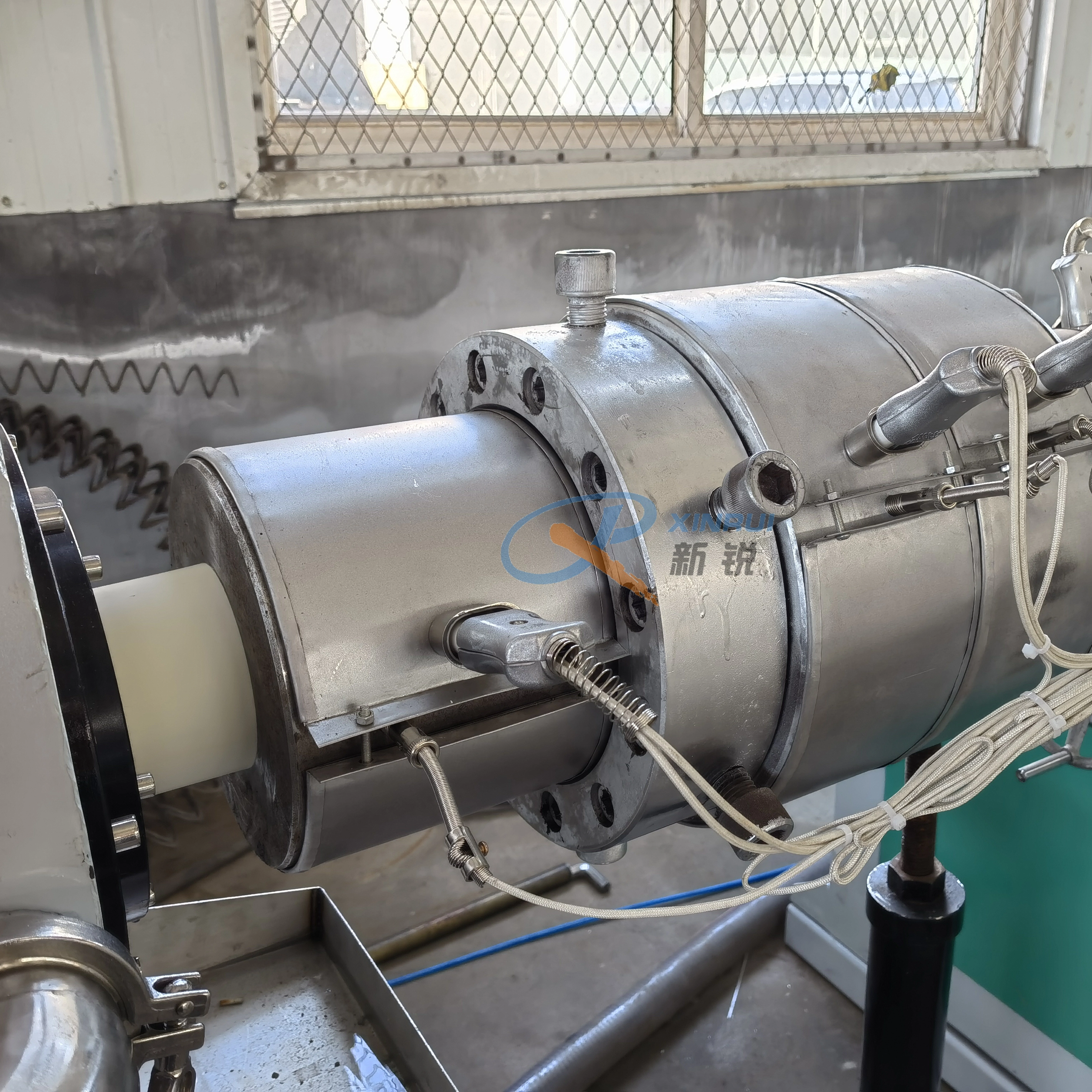
The extruder acts as the heart of the operation. PVC processing strictly relies on twin-screw extruders due to the material's heat sensitivity. Conical twin-screw extruders force the melt through a decreasing volume area. This builds exceptional pressure at the die head, making them ideal for large-diameter pipes. Parallel twin-screw extruders provide a longer residence time. They handle high-filler formulations better because they generate less intense shear heat. Both designs must plasticize the melt completely without triggering thermal degradation.
Once plasticized, the melt enters the die head. This tooling shapes the molten plastic into a cylindrical profile. Manufacturers commonly use spider dies for standard pipes. Spider dies utilize metal legs to hold the central mandrel. However, these legs split the melt stream, sometimes creating weak weld lines in the finished pipe. Basket dies solve this issue. They force the melt through a perforated cylinder, eliminating weld lines entirely and ensuring uniform wall thickness across all axes.
The hot, newly formed pipe exits the die and enters the vacuum calibration tank. Vacuum pressure pulls the soft plastic against a sizing sleeve. This freezes the outer diameter to exact specifications. Following calibration, the pipe enters multi-stage spray cooling baths. You must cool the plastic gradually. Sudden temperature drops cause internal stress and pipe ovality. Spray cooling utilizes less water than full immersion and provides superior heat transfer rates.
The haul-off unit pulls the pipe through the cooling tanks at a precise speed. Haul-off traction must match the pipe diameter perfectly. Small pipes require twin-caterpillar belts. Large-diameter pipes demand four, six, or even eight-caterpillar configurations to prevent slippage. After pulling, the machine cuts the pipe to length. Planetary saws rotate around the pipe, cutting and chamfering the edge simultaneously. Fly-knife cutters slice through smaller pipes rapidly, creating zero dust.
Buyers often mistakenly assume all PVC variants process identically. Different materials demand drastically different equipment requirements. You must match machine metallurgy and drive capacity directly to your intended polymer.
Unplasticized PVC (UPVC) acts as the industry standard for rigid water and sewer pipes. Dedicated UPVC pipe production prioritizes high torque and strict thermal stability. Standard nitride-treated barrels handle UPVC effectively. The temperature control zones must react quickly to prevent the heat-sensitive UPVC from burning. Engineers focus on maximizing output speed while maintaining uniform melt pressure.
Chlorinated PVC (CPVC) withstands much higher temperatures, making it ideal for hot water distribution. However, CPVC processes terribly on standard machinery. Its high melt viscosity generates immense shear friction. Furthermore, the extra chlorine content makes the melt highly corrosive. A dedicated CPVC pipe line requires specialized configurations.
Metallurgy: Standard nitriding fails quickly. You need bimetallic screws and barrels coated with tungsten carbide or similar high-grade anti-corrosion alloys.
Drive Systems: CPVC requires a lower screw RPM to prevent burning, but demands significantly higher torque capacity to push the viscous melt.
Die Design: Tooling requires specialized chrome plating and streamlined flow channels to handle heat-sensitive, high-friction materials safely.
Many plant managers ask if a single line can run both materials. Retrofitting a standard line for dual-use often proves highly inefficient. Changing screws and die heads takes hours, stalling production. We recommend assessing operational goals using this matrix.
Technical Requirement | UPVC Production | CPVC Production |
|---|---|---|
Screw & Barrel Material | Standard Nitrided Steel | Bimetallic Alloy / Tungsten Carbide |
Operational RPM | Medium to High | Low (to avoid shear burning) |
Torque Requirement | Standard High Torque | Ultra-High Torque capacity |
Die Head Plating | Standard Polish | Heavy Chrome / Anti-Corrosion |
OEM brochures often highlight best-case scenarios. Buyers need a skeptical, evidence-based framework for comparing specifications. Evaluating a modern PVC pipe machine requires looking past flashy marketing and analyzing core mechanical data.
Manufacturers frequently advertise maximum theoretical output (e.g., 500 kg/hr). You must test these claims against actual operational constraints. Nominal capacity assumes perfect conditions with ideal resin. Real capacity factors in tooling limitations, filler percentages, and cooling tank length. A machine might extrude 500 kg/hr, but if the cooling tank only chills 350 kg/hr effectively, your real capacity remains capped at 350 kg/hr. Always evaluate output based on the slowest downstream component.
The Length-to-Diameter (L/D) ratio directly dictates melt quality. Typical twin-screw ratios range from 22:1 to 36:1. Higher calcium carbonate filler percentages require a longer L/D ratio to ensure thorough mixing and prevent un-melted particles. You must review the screw design relative to your specific formulation. Aggressive mixing zones work well for highly filled pipes but may burn un-filled pressure pipes.
Electricity forms a massive portion of operating expenses. Evaluate machinery based on Specific Energy Consumption (SEC), measured in kW/kg of processed material. Look for three critical upgrades. Permanent magnet synchronous motors (PMSM) offer higher efficiency than standard AC motors. Insulated heater bands prevent thermal loss into the factory environment. Variable frequency drives (VFDs) optimize power draw across all motors. These features drastically lower long-term power consumption.
Material overweight represents pure lost profit. Operators naturally run lines slightly thick to avoid dropping below minimum standard thickness. Integrating ultrasonic wall thickness measurement solves this. Ultrasonic scanners read the pipe wall 360 degrees in real-time. They connect to a closed-loop control system. If the pipe runs too thick, the system automatically speeds up the haul-off or slows the extruder. This automation eliminates material giveaway completely.
Best Practice: Always request empirical Specific Energy Consumption (SEC) data from the vendor for your exact pipe diameter and filler load before finalizing a purchase.
Auxiliary systems differentiate entry-level setups from highly scalable, commercial operations. Integrating downstream and upstream automation reduces labor dependence and stabilizes output quality.
Manual resin loading introduces contamination risks and creates labor bottlenecks. Commercial facilities utilize automated silo-to-extruder vacuum loading systems. Centralized pneumatic conveying moves resin, fillers, and additives through closed pipes. This prevents dust accumulation on the factory floor and ensures the gravimetric blender never runs dry.
Pipes require flared ends for joint connections. You can perform this manually offline or integrate an automated belling machine in-line. In-line socketing machines sync directly with the extrusion line speed. They heat the pipe end and form either U-type (for rubber gaskets) or R-type (solvent cement) sockets. Proper synchronization ensures the belling process never creates a production logjam.
Scrap generation happens during startup, shutdown, and size changes. Throwing away off-spec pipe destroys profit margins. You must utilize dedicated shredders and pulverizers. Shredders break long pipes into chunks. Pulverizers grind these chunks back into a fine powder. You can safely reintroduce this regrind material into the primary mixer at controlled percentages. Closed-loop recycling protects your bottom line.
Installing heavy industrial equipment rarely happens without friction. Acknowledging what goes wrong during rollout helps you build robust mitigation strategies.
The first 90 days of operation present real-world challenges. Operators face steep learning curves when transitioning to highly automated panels. You must dial in resin recipes to match the specific thermal profile of the new screws. Expect higher scrap rates during this initial period. Dedicate ample time for OEM engineers to conduct on-site training. Rushing the commissioning phase guarantees long-term operational instability.
Identifying root causes quickly prevents massive waste.
Wall Thickness Eccentricity: Usually caused by an improperly centered die pin, or uneven cooling spray in the first vacuum chamber.
Inner Surface Roughness: Indicates moisture in the raw material or inadequate die head temperatures.
Premature Burning: Results from excessive screw RPM, worn barrel zones, or failed cooling fans on the extruder barrel.
Transparent assumptions regarding parts lifespan prevent sudden budget crises. Screws and barrels wear down constantly. Running high-filler formulations (over 30% calcium carbonate) accelerates this wear dramatically. A standard screw processing highly filled resin might require refurbishment after 10,000 hours. Monitor extruder backpressure regularly. Dropping pressure indicates significant screw flight wear. Plan your replacement parts budget accordingly.
Common Mistake: Failing to align the haul-off tracks perfectly with the extrusion axis. Even a one-degree misalignment creates severe internal stress and bends the final product.
Guide your purchasing decision based on guaranteed business outcomes. The cheapest machine upfront frequently becomes the most expensive machine to operate.
A machine holds no value if it cannot consistently produce pipes meeting regional market standards. You must guarantee the equipment can hit strict tolerances. For example, North American markets demand adherence to ASTM D1785 for Schedule 40/80 PVC, or AWWA C900 for municipal water mains. European markets require DIN and ISO compliance. Ask vendors for case studies proving their equipment meets your specific target certifications under continuous operation.
When shortlisting a robust PVC pipe extrusion line, demand transparency. Do not accept verbal assurances. You must evaluate suppliers based on concrete deliverables.
Documented Factory Acceptance Tests (FAT): Require a live run of your specific pipe diameter at the vendor's facility before shipping. Verify the output capacity and dimensional stability in person.
Component Origins: Inspect the bill of materials. Reliable machines utilize globally recognized components, such as Siemens PLCs, ABB inverters, and Zambello gearboxes. Proprietary electrical components make future repairs incredibly difficult.
Clear SLA Terms: Secure a Service Level Agreement detailing commissioning timelines. Ensure it guarantees spare parts availability within specific lead times to prevent prolonged, costly factory downtime.
Sourcing a high-performance extrusion system remains a multi-decade investment. It dictates your operational floor's profitability for years to come. Success requires looking past initial price tags and focusing entirely on sustained yield, melt stability, and material efficiency.
To move forward successfully, prioritize vendors who provide fully transparent energy consumption data. Ensure they utilize verifiable, globally recognized electrical and mechanical components. Finally, demand specialized tooling configurations tailored directly to your exact material requirements, whether you process heavily filled standard PVC or highly corrosive CPVC resins. Taking these steps guarantees a resilient, highly profitable production floor.
A: Lifespan depends heavily on material type and filler content. Processing standard formulations typically yields 15,000 to 20,000 hours of operation. However, running high levels of abrasive calcium carbonate (CaCO3) filler accelerates wear significantly, often reducing lifespan to 10,000 hours before requiring professional refurbishment or complete replacement.
A: While physically possible via extensive retrofitting, it remains highly inefficient. CPVC’s corrosive nature and high melt viscosity demand distinct thermal profiles, ultra-high torque gearboxes, and specialized bimetallic tooling. Swapping components stalls production. Dedicated machines represent the industry standard for maximum efficiency and longevity.
A: Automated closed-loop ultrasonic systems constantly monitor and adjust the pipe wall. They prevent operators from running the pipe overly thick out of caution. By keeping the wall at the lowest acceptable standard tolerance, you eliminate material "giveaway." This raw material savings often pays for the scanner within months.
A: Extrusion requires significant linear space. Depending on the target pipe diameter, a complete setup—including the extruder, vacuum calibration tanks, extensive cooling baths, haul-off tracks, cutters, and automated downstream belling equipment—typically demands 25 to 45 meters of unobstructed linear floor space.