

Views: 0 Author: Site Editor Publish Time: 2026-06-09 Origin: Site


Natural stone brings undeniable beauty to commercial building spaces. However, modern construction projects demand exceptional speed and rapid scale. You cannot easily achieve this using heavy, expensive quarried marble. Traditional materials pose massive logistical hurdles for developers. They incur prohibitive costs, carry extreme weight, and require complex, slow installation methods like dry hanging. Contractors face inevitable delays and shrinking profit margins when relying solely on these conventional options.
A highly specialized PVC marble sheet machine solves these critical challenges entirely. By blending PVC resin and calcium carbonate, manufacturers create lightweight, highly realistic architectural boards. You achieve a premium aesthetic at a fraction of the traditional cost. This guide breaks down the technical architecture, operational efficiencies, and deployment strategies for launching a commercial-grade artificial marble extrusion line. You will learn exactly how to configure equipment, manage high-filler composites, and scale your daily production output.
Compelling ROI: Produces boards at roughly 1/10th the cost and 1/6th the weight of natural stone, with high margins in commercial and residential markets.
Operational Efficiency: Highly automated systems require only 2–3 operators per shift while yielding daily capacities upwards of 500+ standard commercial sheets.
Manufacturing Flexibility: Advanced T-dies allow a single production line to seamlessly adjust board thickness from 1mm to 8mm, with potential adaptability for LVT flooring.
Turnkey Deployment: Standard implementation spans 45–60 days, requiring strict facility planning for utilities, chilling systems, and raw material staging.
Modern building demands push contractors toward smarter material alternatives. PVC marble sheets directly replace traditional UV boards, aluminum composite panels, and natural stone. Healthcare facilities, commercial real estate developers, and public transit hubs increasingly specify these advanced polymer boards. They offer B-grade fire retardancy and superior cost-efficiency. A dedicated artificial marble machine allows you to capture this surging market demand.
You must balance your initial capital expenditure against projected output capacity. A high-capacity line consistently produces between 400 and 1250 kg/h. This variance depends primarily on your chosen extruder configuration. High volume output secures fast amortization for regional manufacturers. You can supply large commercial projects without experiencing inventory bottlenecks.
Installation economics provide a massive selling point for your end-users. PVC sheets completely eliminate the need for cumbersome dry hanging. Installers simply use structural silicone or strong glass glue to mount the panels directly onto walls. One person can easily mount 30 to 40 square meters per day. This streamlined process creates massive demand among time-constrained contractors.
Feature | Natural Stone Marble | PVC Artificial Marble Sheet |
|---|---|---|
Weight Factor | Extremely heavy (requires structural reinforcement) | 1/6th the weight (reduces building load significantly) |
Material Cost | Premium pricing, highly volatile | Approximately 1/10th the cost of stone |
Installation Speed | Slow, labor-intensive dry hanging | Fast, 30–40 sq meters daily per installer using silicone glue |
Flexibility & Machining | Rigid, prone to cracking during cuts | Easily cut, supports 45-degree chamfering and V-grooves |
Understanding the internal engineering of a PVC marble sheet line ensures you make sound purchasing decisions. Each component must handle highly abrasive materials continuously.
You cannot produce high-quality boards without proper material preparation. High-speed SRL-Z mixing units are absolutely necessary. You need both hot and cold mixing stages. These mixers remove residual moisture effectively. They ensure uniform blending of PVC powder, calcium carbonate, and crucial chemical stabilizers. Poor mixing guarantees weak, brittle end products.
Single-screw machines fail completely in this application. You must use conical twin-screw systems, typically ranging from SJSZ80 to SJSZ110 series models. They handle extreme calcium carbonate filler ratios without compromising melt uniformity. Premium machines utilize standard 38CrMoAlA alloy steel. This specific metallurgy provides vital wear resistance against abrasive stone powders.
The extrusion die dictates your product dimensions. Advanced adjustable T-die mechanisms allow operators to change board thickness easily. You can achieve variances from 1mm to 8mm without swapping heavy molds. Following the die, the calendering unit takes over. These 3-roller or 4-roller systems utilize independent oil and water temperature controls. They ensure absolute surface flatness across the entire board.
The finishing sequence brings the product to life. The automated line first executes rigorous dust removal. Next, a 3-roller system applies the UV base and color coating. Infrared leveling smooths the surface perfectly. Finally, specialized UV light stations cure the board. Modern lamination processes operate entirely glue-free. This improves indoor air quality by eliminating formaldehyde off-gassing.
Best Practice: Always maintain strict temperature logs for your oil and water calendering rollers. Consistent thermal management prevents surface rippling.
Common Mistake: Rushing the hot/cold mixing cycle. Failing to extract all moisture during the mixing stage causes microscopic bubbles inside the extruded board, ruining structural integrity.
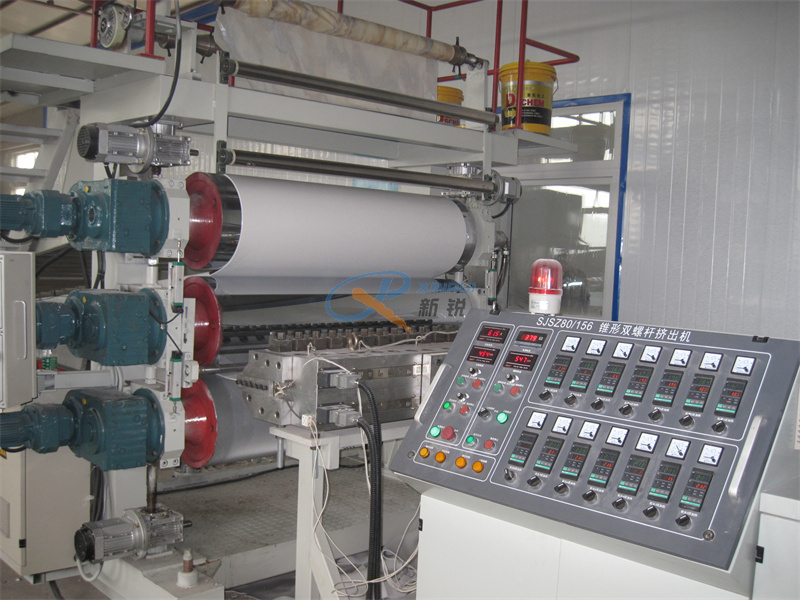
A synchronized workflow guarantees high daily yields. The entire manufacturing sequence moves continuously from raw powder to palletized boards.
Formulation & Feeding: Operators load blended raw materials into vacuum loaders. These loaders feed the compound into the extruder via parallel twin-screw feeders. This specific feeder design prevents bridging and blockages in the hopper.
Melt & Extrusion: The compound enters the heated barrel. The machine melts it under precise, zone-controlled heating. Intelligent Siemens or Omron PLC logic systems monitor these zones. The twin screws force the molten plastic through the flat die under immense pressure.
Surface Treatment (Lamination & Embossing): The PVC exits the die in a hot, semi-molten state. High-definition 3D stone texture films meet the board here. The calendering rollers hot-press these films directly onto the substrate. This achieves a simulation rate exceeding 95%.
Cooling, Haul-off, and Cutting: The continuous sheet travels outward through a dedicated cooling bracket. A multi-belt haul-off machine pulls the heavy board gently. This prevents stretching and warping. Finally, an automated transverse saw cuts the sheet to length. Automatic robotic stackers handle the final palletizing step. They minimize manual labor drastically.
Production Stage | Primary Equipment | Critical Action |
|---|---|---|
1. Mixing | SRL-Z Hot/Cold Mixer | Moisture removal and uniform blending |
2. Extrusion | Conical Twin-Screw Extruder | High-pressure melting and compounding |
3. Shaping | T-Die & Calendering Rollers | Thickness calibration and hot-press lamination |
4. Finishing | UV Coating & Curing Unit | High-gloss protection and surface hardening |
Choosing the correct equipment vendor determines your long-term profitability. You must scrutinize the mechanical specifications carefully. A robust UV marble panel machine requires high-grade components.
First, examine the screw design meticulously. High fillers destroy weak metals quickly. Warn your procurement team that poorly designed screws will wear rapidly under extreme calcium carbonate loads. Verify the supplier uses specialized screw geometry. They must design the thread profile specifically for high-filler PVC composites.
Next, review the energy and automation specifications. Look for variable frequency drives (VFDs) on all main motors. They curb power consumption noticeably. A fully synchronized PLC system remains critical. It prevents disastrous thickness inconsistencies whenever you change the extrusion speed.
Assess production scalability before signing any contracts. You want equipment capable of adapting to market shifts. Minor downstream modifications to a robust PVC wall panel machine setup offer great flexibility. They allow manufacturers to pivot into producing LVT flooring. You can also vary the thicknesses of decorative panels quickly.
Prioritize vendors offering complete turnkey engineering and strict quality assurance. You need complete layout blueprints before machines arrive. Ensure the vendor utilizes in-house CNC machining for core components. Demand rigorous pre-shipment simulated factory testing. Do not accept machines blindly without a documented test run.
Buying the machine represents only half the battle. Successful deployment requires meticulous facility preparation and operational readiness.
Understand the space and layout demands immediately. A complete extrusion, UV coating, and packing line requires substantial linear factory space. Outline exact footprint expectations with your vendor. Standard lines often exceed 35 to 40 meters in total length. You must also account for raw material staging and finished goods storage.
Prepare your utility prerequisites well in advance. Factory requirements are non-negotiable. You need highly stable industrial electricity. Chilled water circulation systems must handle immense heat loads continuously. Robust compressed air infrastructure is mandatory for pneumatic valves and cutting saws.
Focus heavily on formulation and training transfer. A world-class machine remains useless without the correct recipe. Select suppliers who willingly provide the precise chemical formulation matrix. They must deploy engineers for comprehensive on-site operational training. Your local crew needs hands-on experience handling the hot melt.
Implement a zero-waste loop setup from day one. We highly recommend integrating an edge-trimming crusher and a heavy-duty pulverizer into your factory layout. This equipment allows you to immediately recycle edge scrap. You feed pulverized material back into the production cycle. This protects your profit margins relentlessly.
The transition to manufacturing PVC imitation marble serves as a reliable bottom-line driver. Plastics extruders and building material suppliers stand to gain immense market share. Success depends entirely on procuring equipment capable of handling continuous, high-filler extrusion without excessive wear. Automated lines reduce your dependency on manual labor while maintaining strict product consistency.
Decision-makers should take immediate action. Audit your available factory floor space carefully. Secure localized utility estimates for power and chilled water. Finally, request a comprehensive formulation breakdown from shortlisted equipment manufacturers before committing to your capital expenditure. Thorough preparation guarantees a smooth, highly profitable rollout.
A: Depending on the extruder model, output ranges from 400 kg/h to over 1200 kg/h. This roughly translates to 500+ standard commercial sheets (1220mm width, 3mm thickness) per 24-hour shift.
A: Yes. With the correct filtration and parallel twin-screw setup, manufacturers can incorporate a percentage of regrind material alongside fresh PVC resin and calcium carbonate. This significantly lowers material costs.
A: Most top-tier suppliers require 45 to 60 days for custom manufacturing, assembly, and QC. This is usually followed by a 1-to-2-week on-site commissioning and training phase at the buyer's facility.
A: Modern lines use hot-press lamination without liquid adhesives (no glue drops). They employ enclosed UV curing stations. This ensures zero formaldehyde release and aligns with stringent indoor environmental safety standards.


