Views: 0 Author: Site Editor Publish Time: 2026-06-06 Origin: Site
The commercial construction industry is rapidly shifting away from traditional building materials. Builders no longer want rot-prone wood, heavy ceramics, or peeling wallpaper. They demand lightweight, waterproof, and B1 fire-retardant alternatives. This massive shift has heavily accelerated demand for modern plastic panels across residential and commercial sectors. Transitioning to PVC panel manufacturing presents a very specific procurement challenge. You must carefully balance aggressive cost-reduction techniques against strict quality demands. Using high-filler formulations saves money. However, your final product still needs perfect dimensional stability and a flawless surface finish. This article provides a transparent, technical evaluation framework. It will help you shortlist and configure a commercial PVC ceiling panel machine effectively. You will learn how to ensure high yield, secure a predictable ROI, and maintain incredibly low defect rates in daily operations.
Twin-screw superiority: Conical twin-screw extruders are non-negotiable for PVC powder mixes, offering the shear and compounding needed for high-calcium carbonate (CaCO3) formulas.
Formulation dictates profitability: Modern lines can handle up to 300phr of CaCO3, drastically lowering raw material costs without compromising panel integrity.
Energy and yield metrics: Tier-1 machines achieve baseline energy consumption as low as 25kW/h while maintaining outputs of up to 4,800 sqm per 24-hour cycle (depending on the extruder model).
Risk mitigation: Surface flaws and panel warping are primarily solved through advanced vacuum calibration and PID temperature controls, not just raw material tweaks.
A robust manufacturing line requires seamless coordination between multiple high-precision components. If one module fails, you risk bottlenecks and massive material waste. Evaluating the hardware categories below will help you establish a strong technical baseline for your factory.
Raw Material Feeding & Blending: Your process starts here. Automated spiral loaders feed the raw materials into the system. High-speed hot and cold mixers then process the blend. They ensure a perfectly homogeneous mixture of PVC resin and essential additives. If you compromise on mixer quality, you will suffer from inconsistent batches.
Conical Twin-Screw Extruder (The Core): You cannot rely on single-screw machines for this application. Single-screw units fail because they cannot properly plasticize complex PVC powder and filler blends. Conversely, twin-screw systems excel. They offer superior degassing capabilities. They provide controlled shear and robust homogenization. You absolutely need these traits for continuous wall panel extrusion. Furthermore, conical designs build high melt pressure naturally at the die head.
T-Die and Extrusion Tooling: The die head acts as the shaping mold. Precision-machined dies dictate the internal structure of your panels. For example, they create round holes for Stone-PVC. They form square or rectangular holes for Wood-PVC. High-grade tooling uses chrome plating to resist wear from abrasive fillers.
Vacuum Calibration & Cooling Table: This module serves as the critical zone for dimensional stability. It utilizes multi-zone water cooling and vacuum sizing. This combination instantly locks the panel's shape as it exits the hot die. Excellent cooling tables prevent structural warping and ensure flat surfaces.
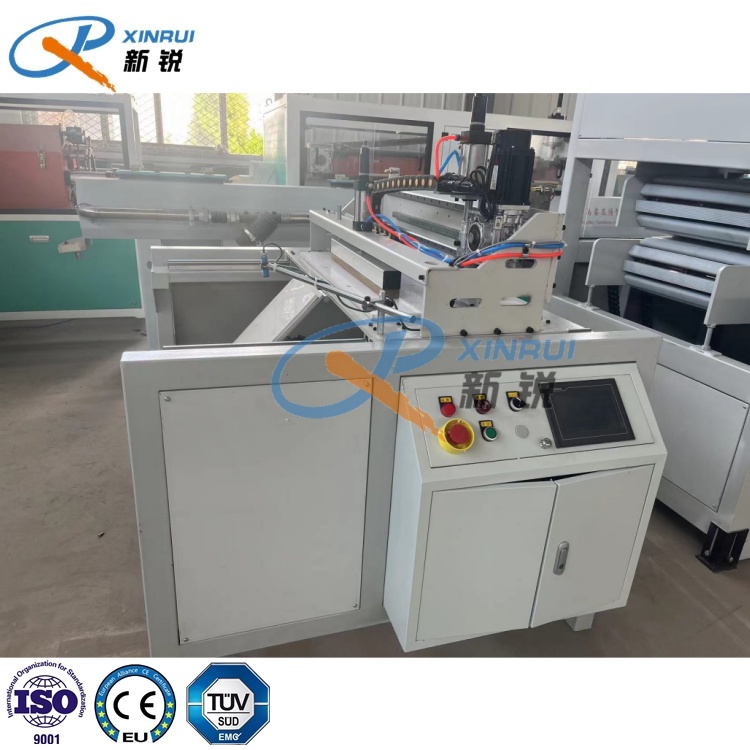
Haul-off and Cutting Units: You must pull the cooled panel evenly. Caterpillar (crawler) haul-offs handle this delicate task. They use infrared tracking to eliminate flow rate fluctuations. High-quality rubber contact pads prevent surface scratches. Paired with automated cutters, they size panels precisely for standard shipping constraints. Common lengths include 5.8m for 20ft containers and 5.95m for 40ft containers.
Your profit margins depend directly on your material recipes and hardware capacity. Understanding this relationship helps you maximize your operational returns. Formulating correctly reduces daily expenses drastically.
Unpacking the recipe reveals the secret to both structural integrity and cost-efficiency. Manufacturers blend specific chemicals to achieve the exact right balance. You must source these ingredients reliably.
Base & Filler: PVC Resin SG-5 forms the core matrix. Calcium carbonate (CaCO3) acts as the primary filler. You can scale CaCO3 up to 300phr to drive down unit costs significantly.
Stabilizers & Lubricants: You need stearic acid and PE wax in your mix. They prevent premature thermal degradation. They also optimize melt flow within the hot barrel.
Performance Modifiers: Titanium dioxide (TiO2) adds critical UV resistance and baseline whiteness. Chlorinated Polyethylene (CPE) enhances overall flexibility and impact resistance.
When sizing your PVC panel machine, align your budget with your expected daily outputs. The chart below outlines standard equipment tiers and their expected yields.
Extruder Model | Target User Profile | Estimated Yield (24 Hrs) | Coverage Area (24 Hrs) |
|---|---|---|---|
SJSZ65/132 | Entry-to-Mid Level Entrants | Approx. 8,000 kg | Approx. 3,000 sqm |
SJSZ80/156 | High-Volume Manufacturers | Approx. 12,000 kg | Approx. 4,800 sqm |
New market entrants often start with the SJSZ65/132 model. It balances upfront costs with highly respectable daily outputs. Established manufacturers scaling their operations typically choose the SJSZ80/156 model. It maximizes yield and lowers the per-square-meter labor cost.
Even the best equipment requires precise calibration. Implementation realities often bring unexpected physical challenges. Let us look at common troubleshooting steps for your ceiling panel line. Addressing these flaws early prevents material waste.
Root Cause: Uneven cooling or aggressive pulling usually causes this frustrating issue. If one side of the panel cools faster than the other, internal stresses force the plastic to warp.
Machine Solution: Upgrade your vacuum calibration tables immediately. You need independent multi-zone water cooling to manage temperature gradients. You also must synchronize your haul-off speeds exactly with the main extrusion rate. Consistency is your best defense here.
Root Cause: Excess moisture in the raw material mix often causes blisters. Trapped gasses during the initial plasticization phase also create ugly surface bubbles.
Machine Solution: Rely on highly optimized degassing zones within the twin-screw barrel. A powerful water-ring vacuum pump will safely vent volatile gasses before they ever reach the die head. Furthermore, ensure your hot mixer removes residual humidity during the blending stage.
Root Cause: Fluctuating melt pressure forces uneven material flow. This fluctuation ruins your ability to lock the board into the correct thickness.
Machine Solution: Integrate premium PID temperature controllers into your control cabinet. Omron is a highly trusted brand for this application. Pair them with high-tier inverters from companies like ABB. This combination maintains exact screw RPM. It ensures a beautifully consistent melt flow all day long.
The core extrusion process gives the panel its physical shape and structural strength. However, the downstream decoration step provides its final marketability. Consumers buy based on aesthetics. You have two primary finishing methods to choose from for your production line.
This technique transfers special ink directly onto the board via heated silicone rollers. It applies intense heat and steady pressure. The process is excellent for creating high-gloss marble or classic tile imitations. Hot stamping features lower operational complexity compared to other methods. You avoid messy glues and extensive drying times entirely. It remains the absolute best choice for Stone-PVC applications.
Lamination applies a decorative PVC film using specialized, highly durable adhesives. This approach yields deep wood grain textures. It provides a superior tactile feel that high-end buyers demand today. The machinery requires precise tension control to avoid wrinkling the film. It represents the best finishing solution for Wood-PVC and highly textured wallboards.
A professional setup should always remain flexible. Your complete line should allow modular switching between downstream finishing units. This adaptability lets you pivot quickly. You can shift from making glossy marble panels in summer to textured wood panels in winter. Modular systems protect you against sudden shifts in seasonal market demand.
Choosing the right supplier requires strict shortlisting logic and thorough technical verification. You must look far past the initial price tag. Focus heavily on commercial terms, real-world testing, and verifiable technical guarantees.
You should heavily scrutinize the claimed power draw of any proposed machinery. Electricity costs will eat into your long-term operating margins. Leading PVC decoration panel machine manufacturers achieve remarkable efficiency. Through optimized motor designs and insulated heater bands, they can lower total bus power consumption to a baseline of just 25kW/h. Ask your supplier for documented proof of these consumption rates.
Always reject proprietary, black-box electronics. If a custom circuit board breaks, your entire factory stops. You will lose days waiting for parts from overseas. Demand internationally recognized electrical components instead. Look for trusted names like ABB, Schneider, and Siemens in the control cabinet. This standardization ensures local replacement part availability. It minimizes sudden downtime effectively.
Never accept a machinery shipment blindly. Require a successful FAT run using your specific material formulation before they pack the container. The machine must prove it can handle your exact high-calcium recipe without stalling.
For payment safety, stick to standard commercial structures. A common breakdown is a 30% T/T advance payment. You then pay the remaining 70% via T/T or a secure L/C before delivery. Always verify these financial conditions using strict FOB or CIF terms to define shipping liabilities clearly.
Investing in plastic panel extrusion equipment is fundamentally an exercise in risk management and aggressive margin optimization. Your ultimate success relies entirely on matching a highly efficient twin-screw extruder with a low-cost, high-yield material formulation. Mastering this balance secures your profitability.
To move forward effectively, follow these actionable next steps:
Request a detailed machinery layout drawing from prospective suppliers to verify your spatial factory requirements.
Demand an itemized breakdown of all electrical components to confirm international brand usage.
Ask for baseline formulation sheets from the manufacturer to calculate your exact return-on-investment periods.
Schedule a live video audit of the manufacturer's assembly floor to verify their true production capacity.
A: With appropriate die head changes and a sufficiently sized calibration table, a single line can typically accommodate widths from 300mm up to 800mm. You simply must ensure your haul-off and cutting units match the wider specification limits.
A: Yes. Because the extrusion process relies on thermal plasticization rather than chemical glues for the core structure, the resulting panels are zero-formaldehyde and paint-free. Furthermore, factory scrap and old panels remain fully recyclable into new production batches.
A: Stone-PVC heavily relies on CaCO3 fillers and usually features a round-hole internal structure. Manufacturers finish it via hot stamping. Conversely, Wood-PVC incorporates 40-70% wood flour. It typically features square or rectangular structural holes and is finished via surface lamination.
A: Yes. By changing the extrusion mold (T-die) and adjusting the downstream calibration tooling, the same core line can extrude various profiles. You can easily produce different thicknesses (commonly 5mm to 9mm) and internal structures using one main extruder.