Views: 0 Author: Site Editor Publish Time: 2026-05-25 Origin: Site
Profitability in industrial plastic sheet production hinges directly on dimensional stability and defect reduction. It goes far beyond raw throughput. Downstream buyers, like CNC machining shops and fabricators, require a premium HDPE board to ensure seamless final assembly. They need materials featuring zero internal stress, precise thickness, and consistent density. Failing to meet these strict standards often results in immediate material rejection. The boards might warp or melt during later fabrication stages.
Optimizing an HDPE board machine requires mastering thermodynamics, cooling calibration, and complex polymer behavior. Operators must understand how the plastic behaves from the hopper all the way to the haul-off unit. This comprehensive guide breaks down the essential processing parameters necessary for success. We will explore equipment evaluation criteria designed for scaling high-yield PE sheet production.
Thermal Control is Non-Negotiable: HDPE’s specific melting point (~130°C) and high coefficient of linear thermal expansion (CLTE) dictate multi-zone temperature regulation in the extruder barrel.
In-Line Stress Relief: Premium plastic sheet production lines must incorporate annealing/tempering stages to prevent downstream warping and surface cracking during CNC machining.
Material Versatility: Modern extrusion configurations support composite blending (e.g., Wood Flour Composites/WFC or natural fillers) to enhance mechanical rigidity and sustainability.
Decision Matrix: Evaluating a plastic board machine requires assessing screw L/D ratios, calendering roller precision, and automated thickness controls.
B2B buyers face severe fabrication challenges when handling substandard plastics. Viscoelasticity often causes aggressive tool deflection during CNC operations. Furthermore, the low thermal conductivity of polyethylene means heat stays at the cutting edge. This localized heat leads directly to friction-induced melting and ruined finishes. Upstream producers must account for these downstream realities.
The optimal manufacturing solution begins inside the extrusion line. To produce a highly machinable board, the system must eliminate internal stresses entirely before the sheet cools. Any trapped thermal energy will release later during cutting, causing catastrophic warping.
Manufacturers must hit specific success criteria to deliver acceptable materials:
Maintain a consistent melt flow index (MFI): Steady polymer viscosity ensures a uniform density across the entire panel.
Achieve uniform molecular orientation: This crucial step prevents the "springback" effect when machine tools remove material.
Deliver strict thickness tolerances: Top-tier lines achieve ±0.1–0.2 mm variance across extremely wide formats.
Mastering HDPE processing requires a granular understanding of thermal and mechanical inputs. Every zone along the line impacts the final material structure.
Operators utilize step-by-step heating zones to gradually bring raw PE granules past the 130°C melt threshold. Aggressive, sudden heating degrades polymer chains and weakens the final product. Progressive zones typically ramp up from the feed section to the metering section.
Die lip temperature optimization remains equally critical. Incorrect die temperatures cause "sharkskin" or melt fracture on the surface. Operators must fine-tune the die heaters to keep the flow smooth and predictable.
Finding the perfect balance between sheer heat and mechanical mixing is vital. Running the screw at excessively high RPM generates friction. This friction burns or degrades the resin. Conversely, operating at too low an RPM leaves un-melted nodes inside the melt stream.
Barrier screws separate the solid bed from the melt pool.
They ensure homogeneous melting throughout the entire cycle.
Optimized thread pitches prevent surging at the die lip.
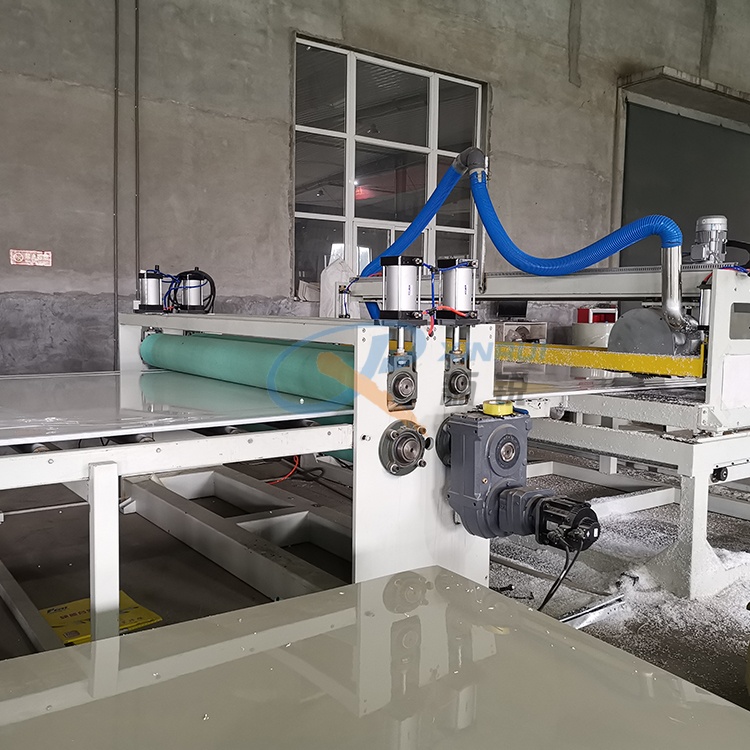
The 3-roller stack dictates the final finish and initial cooling phase. Operators must map roller temperatures carefully to manage the gradual transition from melt to solid.
Rapid chilling causes extreme problems. If you chill the surface too fast, the outer layer shrinks immediately. The core remains molten and expands. This differential traps massive internal stress. Later, this stress becomes the leading cause of warped boards during CNC milling.
Controlling defects requires proactive engineering. Premium extrusion setups integrate dedicated cooling zones designed specifically for stress management.
The best plastic extrusion lines feature a prolonged cooling and annealing bracket. Annealing serves a fundamental purpose in polymer manufacturing. By gradually reducing the temperature from around 80-100°C down to room temperature, the polymer chains relax. This controlled environment releases residual stress naturally. Consequently, the board stays completely flat during extreme CNC milling or sawing.
Operators need clear protocols when visual defects appear on the line. Use the table below to identify, diagnose, and resolve common production issues rapidly.
Symptom | Probable Cause | Machine Fix / Adjustment |
|---|---|---|
Transverse waves or chatter marks | Extruder surge or inconsistent roller pull speed. | Synchronize the gear pump and haul-off drives precisely. |
Edge curling or bowing | Uneven cooling between the top and bottom calendering rollers. | Re-calibrate coolant flow and temperature in the roller stack. |
Surface pits or internal bubbles | Moisture in the raw material or poor outgassing. | Ensure the vacuum venting system on the extruder barrel is functioning. |
Modern production demands flexibility. Expanding into specialized markets requires equipment capable of handling complex formulations and layered structures.
Advanced setups utilize multiple extruders feeding into a single die block. This technique creates robust boards featuring virgin HDPE outer layers. Simultaneously, operators feed recycled or regrind materials into the core layer. This approach optimizes material costs while maintaining pristine surface aesthetics.
You can adjust machine parameters to handle Wood Flour Composites (WFC) or natural hydroxyapatite (n-HAp) fillers. These additives significantly increase the final board's tensile strength. They also improve surface hardness, making the product ideal for heavy-duty industrial flooring or architectural panels.
Shifting between material grades requires immediate parameter adjustments. Operators regularly transition between Standard, UV-Resistant (for outdoor marine decking), and High Molecular Weight (HMW) production. A high-end plastic sheet production line stores these specific recipes in its PLC, ensuring quick changeovers.
Purchasing capital equipment requires strict technical evaluation. You must analyze the mechanical components driving the entire process.
Examine the core architecture of the equipment before making a decision.
Drive and Motor Efficiency: Direct-drive servo motors provide superior torque control compared to traditional AC motors. They offer long-term energy savings and smoother screw rotation.
L/D Ratio (Length to Diameter): A higher L/D ratio, such as 30:1 or 33:1, is critical. It ensures optimal plastification during continuous operation without overheating the resin.
Automation Integration: Modern PLC control systems store complex recipe parameters. This guarantees repeatable, high-yield runs across different operator shifts.
The following chart illustrates the operational differences between entry-level systems and advanced extrusion lines.
Capability Feature | Standard Equipment | Advanced Equipment |
|---|---|---|
Melt Pressure Control | Manual die lip adjustment | Integrated gear pump with automated feedback loop |
Cooling System | Basic ambient air rack | Enclosed, temperature-controlled annealing bracket |
Material Handling | Single virgin feed hopper | Gravimetric dosing for multi-component blends |
Thickness Tolerance | ±0.5 mm variance | ±0.1 mm variance |
Watch out for severe red flags during your procurement phase. Avoid extrusion lines lacking a dedicated melt pump (gear pump). Skipping this component leads directly to uneven die pressure and wildly inconsistent board thickness.
Assess your own facility constraints accurately. Ensure you possess an adequate factory footprint for the required downstream cooling length. Truncating the cooling rack guarantees warped output. You cannot compress the physics of polymer cooling.
Define your exact sheet width and thickness requirements clearly. Request pilot runs from equipment manufacturers using your specific resin blends. A reliable plastic board machine supplier will demonstrate consistent output matching your desired tolerances.
Profitable industrial sheet production represents a delicate balance of thermal management and mechanical precision. The right equipment prevents costly material defects at the source, eliminating downstream rejections.
Investing in a machine featuring advanced cooling, vacuum venting, and precise parameter controls secures your position in the market. You will operate as a highly reliable supplier to demanding CNC fabrication and engineering sectors.
Take proactive steps today. Consult extrusion engineering specialists to specify a machine tailored precisely to your exact production volume and niche application requirements. High-quality output begins with masterful equipment selection.
A: The ideal profile utilizes progressive heat zones. Temperatures typically range from 160°C at the feed section up to 220°C at the die. The exact temperatures depend on your specific material grade, throughput goals, and screw design.
A: The system controls thickness through three interacting elements. Operators adjust the die lip manually or automatically. The melt pump maintains constant pressure, pushing a steady volume. Finally, the exact gap set between the calendering rollers locks in the final dimension.
A: Warping almost always results from rapid cooling and the absence of a proper annealing stage. Rapidly chilling the outer layer while the core remains hot locks in internal stress. This stress releases dynamically when CNC tools cut into the board.
A: Yes, modern extrusion lines handle recycled materials exceptionally well. By utilizing co-extrusion blocks, you can hide regrind pellets in the core layer. Furthermore, strong vacuum venting removes moisture and volatiles common in recycled feedstocks.